“For if there is one point on which all religious historians agree, after many useless quarrels, it is the obvious fact that Christianity was not invented on its own in the West and that it was not constructed out of whole cloth.
This imported religion was compelled to inscribe its doctrine and commemorations in the pagan calendar predating its arrival in order to better assimilate the preexisting beliefs…”
Walter, Philippe – Christian Mythology
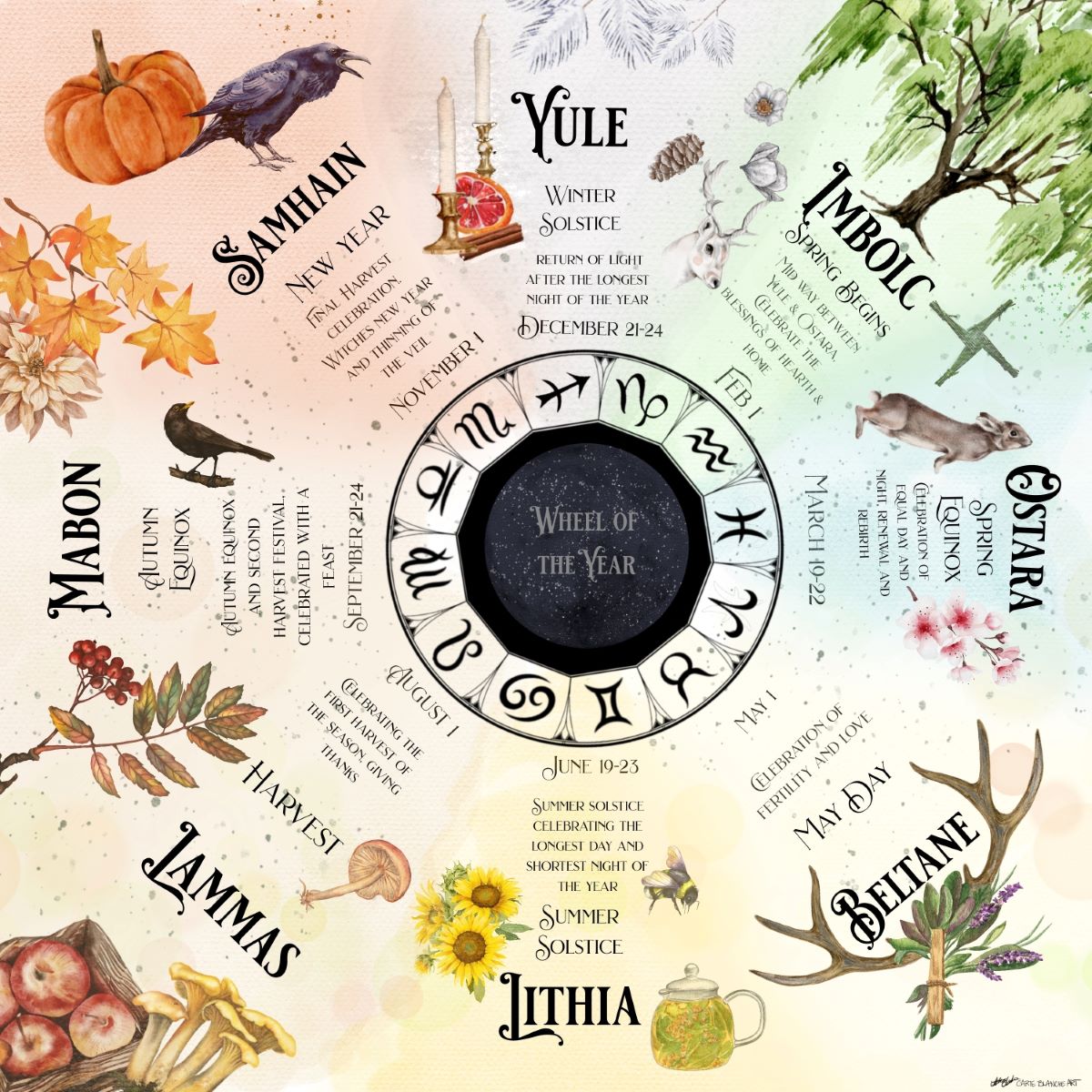
The Wheel of the Year and Pegan Holidays
Pagan Holidays and the Wheel of the Year are often celebrated by Pagans, Witches, Wiccans, and anyone interested in Nature Spirituality. There are many different ways to honor the seasons! The choice is entirely up to you.
There is some debate around the names, dates, and which spiritual practitioner celebrates each holiday. However, there’s no wrong way to celebrate the seasons and cycles of Nature. It’s a very personal part of your spiritual practice.
As beginners, you need to start by letting go of these “rules” placed on us by others. You don’t need to celebrate every holiday to be a “real” Pagan, Witch, Wiccan, or spiritual person. Focus on the meanings and symbolism behind each holiday and incorporate the holidays and practices that resonate with you.
Each Pagan holiday is a time to slow down and be present. Every holiday symbolizes the changing of seasons, representing an important time of transition. Acknowledge what you are feeling. What do you need out of life, what are you grateful for?
The modern-day Wheel of the Year was first suggested by the scholar and mythologist Jacob Grimm (1785-1863) in his 1835 CE work, Teutonic Mythology, and fixed in its present form in the 1950s and early ’60s CE by the Wicca movement to modernize ancient Pagan traditions. They pulled from Celtic and Middle East celebrations, among others.
Sabbats – sab·bat
There are 8 major holidays throughout the year roughly 6 weeks apart, known as Sabbats in the Wheel of the Year. Sabbats allow us to better appreciate nature, and the gifts and challenges held within each season.
The calendar that holds the Sabbats is often referred to as the Wheel of the Year. The celebration of each Sabbat is as individual as those celebrating, though there are some rough guidelines for each festival that you’re welcome to follow, add to, or adjust in a way that suits you and your needs. There are no hard and fast rules, simply guidelines and rationale behind the ritual choices.
The Sabbats are divided into two types: Greater and Lesser. The designation has nothing to do with importance but with what they represent.
The Greater Sabbats celebrate agricultural cycles, the natural cycle of life, death, and rebirth. These four Holiday Sabbats are rooted in Celtic history and origins. The day of celebration lands on the same date every year;
- Imbolc [im-blk] –Brigid/Candlemas- February 1st – 2nd?
- Beltane [bel·tayn]– May Eve/Walpurgis – April 30th – May 1st?
- Lughnasadh [Loo-nuss-uh] – August Eve/Lammas – August 1st
- Samhain [sah-win] – Hallows Eve – October 31st
The Lesser Sabbats are solar celebrations that honor where the sun is located in the sky. They coincide with the two solstices and two equinoxes. The dates of the Lesser Sabbats are determined astronomically so they fluctuate from year to year;
- Ostara [o-stahr-uh] – Spring Equinox -March 20-23
- Litha [Lee-thuh] – Summer Solstice/Longest day – June 20-23
- Mabon [MAH-bon] – Fall Equinox – September 20-23
- Yule [YOOL] – Winter Solstice/Shortest day – December 20-23
The Major Sabbats are Beltane, which focuses on life; and, Samhain, which focuses on death, two distinct and opposite aspects. These two events take place when the veil between the earthly dimension and the spirit dimension is the thinnest. What does that mean? Communications between the two dimensions are more likely to be successful for a week or so before and after each of these two events.
Any and all Sabbat observances are fluid and dependent upon your personal beliefs and comfort level. There are no rules for behavior or participation.
 Cambria Black Hat Society